How to Choose the Right Photoelectric Sensors for Your Needs?
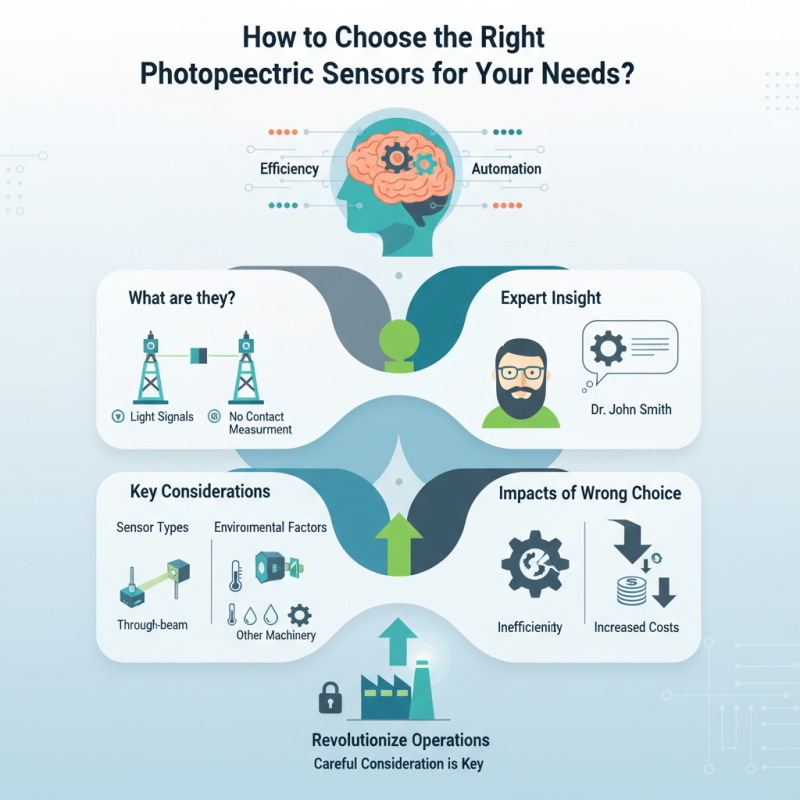
In the realm of automation and industrial applications, selecting the right Photoelectric Sensors is crucial. Renowned expert Dr. John Smith states, "Choosing the right sensor can enhance efficiency." With various types available, understanding their unique features is essential.
Photoelectric Sensors detect objects and measure distances without contact. They use light signals and can be affected by factors like dust or humidity. Ensuring compatibility with your system can be challenging. Each application demands specific sensor types, such as through-beam or reflective sensors. The wrong choice may lead to operational inefficiencies and increased costs.
Moreover, many users overlook environmental factors that impact sensor performance. It's vital to consider settings, like temperature or the presence of other machinery. Making an informed decision requires thorough research and reflection. The right Photoelectric Sensors can revolutionize your operations, but careful consideration is key.
Factors to Consider When Selecting Photoelectric Sensors for Applications
When selecting photoelectric sensors for specific applications, several key factors should be considered. The sensing range is critical. Many sensors operate effectively within a range of 10 to 50 meters. Understanding this can prevent issues, especially in large environments. The response time also plays a significant role. For high-speed applications, a response time under one millisecond is often required. Higher speeds can lead to missed detection.
Environmental conditions should not be overlooked. Dust, moisture, and temperature can impact sensor performance. According to industry reports, approximately 30% of sensor failure is due to improper environmental compatibility. Selecting sensors with the right IP rating can enhance longevity. For example, an IP67 rating ensures dust-tight and waterproof capabilities.
Reflective properties of surfaces are another factor to keep in mind. Different materials reflect light differently. Thus, calibration is needed for accurate detection. It's vital to test sensors in real-world situations before final selection. This helps identify potential misalignments or detection issues that may not be apparent during theoretical evaluations.
Understanding Different Types of Photoelectric Sensors and Their Uses
Photoelectric sensors come in various types. Each type serves different purposes. Understanding these types is crucial for effective application. The most common types are diffuse, retroreflective, and through-beam sensors.
Diffuse sensors work by using the light reflected off an object. They are widely used in packaging industries. However, they can sometimes misread shiny surfaces. Retroreflective sensors employ a reflector to bounce the light back. This type is often found in conveyor systems. Yet, they may have difficulty when the reflector is out of alignment.
Through-beam sensors send a beam from the emitter to the receiver. They boast high precision and are effective in detecting small objects. Still, installation can be challenging. Choosing the right sensor involves considering the environment it will be used in. Analyzing the objects to be detected matters too. Take time to weigh these factors carefully.
Key Performance Metrics: Sensitivity, Response Time, and Resolution
When selecting photoelectric sensors, understanding key performance metrics is essential. Sensitivity is a crucial factor. It determines how well a sensor detects objects. A more sensitive sensor can pick up smaller or more distant objects. But, high sensitivity may lead to false readings. Balancing sensitivity with accuracy is often a challenge.
Response time also plays a significant role. It indicates how quickly a sensor can react to changes. A faster response can enhance efficiency in automation environments. However, a sensor with an ultra-fast response time might sacrifice some level of stability. Finding the sweet spot requires careful consideration of the specific application.
Resolution is another metric not to overlook. It refers to the sensor's ability to distinguish between two closely placed objects. Higher resolution enables precise measurements. Yet, it can increase costs and complexity. Evaluating the actual need for resolution in your project is vital. Reflecting on these performance metrics can guide you to the right choice, but it’s a nuanced decision that often needs revisiting.
Industry Standards and Certifications for Photoelectric Sensors
Choosing the right photoelectric sensors involves understanding industry standards and certifications. These ensure devices meet safety, reliability, and performance criteria. Familiarize yourself with common certifications like CE, UL, and IEC. These marks indicate that a product has been tested and verified to comply with specific regulations.
Tips: Check for certifications that match industry requirements. This will help simplify your decision-making process. Not all sensors will have the same certifications, and missing a key one could lead to issues down the line.
Many industries have specific requirements. For example, food and beverage sectors may need sensors that withstand harsh cleaning processes. Understanding these unique needs can guide your selection.
Tips: Always consult with a technical expert if you're unsure. They can provide insight into choosing the right sensor based on application and standards. Not every sensor is a perfect fit for every setting. Taking time to assess your options can save future headaches.
Comparison of Different Types of Photoelectric Sensors
This bar chart illustrates the detection range of various types of photoelectric sensors, highlighting their operational capabilities across different environments.
Cost-Benefit Analysis of Photoelectric Sensors in Automation Systems
When evaluating photoelectric sensors for automation systems, a cost-benefit analysis is crucial. These sensors can optimize processes, but they come at a cost. A well-chosen sensor might reduce operational downtime and improve efficiency. However, poor choices lead to wasted resources and ineffective functionality.
Consider the installation and maintenance costs. Some sensors require more frequent maintenance. Others might have higher upfront costs but offer greater reliability over time. Calculate the total cost of ownership. It's essential to evaluate not only the initial price but also how long the sensor will last and the expenses tied to its upkeep.
Tips: Inspect the sensor's specifications closely. Look for durability ratings and environmental resistance. Assess whether the sensor is suitable for your technical environment. Evaluate different types, like diffuse and thru-beam sensors. Understand specific application needs and operational contexts.
Don't forget user feedback. Engage with industry forums to gather insights. Monitor performance issues that users face. Sometimes, the best choice comes from real-world applications rather than purely theoretical features. Keep an open mind. The perfect sensor often doesn't exist; compromises may be necessary.