How to Choose the Right Gate Valve for Your Needs?
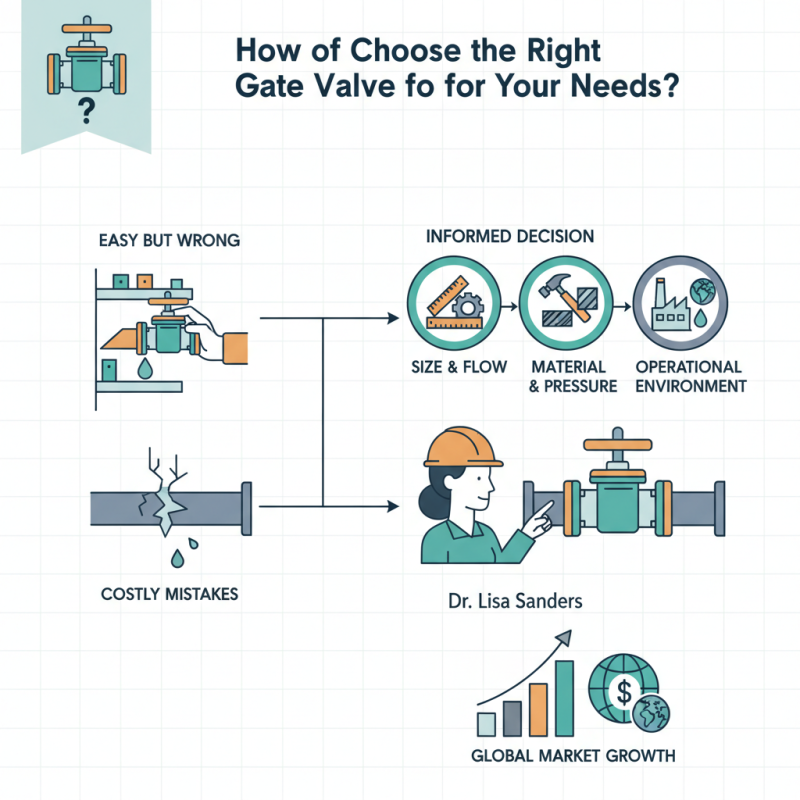
Choosing the right Gate Valve is crucial for various industrial applications. According to a recent industry report by Global Market Insights, the gate valve market is projected to reach $8 billion by 2026, driven by increasing infrastructure development. However, the selection process can often lead to confusion, as not all gate valves serve the same purpose.
Industry expert, Dr. Lisa Sanders, states, “A gate valve must meet specific pressure and flow requirements to function optimally.” This highlights the importance of understanding your individual needs. Factors such as size, material, and operational environment significantly impact valve performance.
While many users overlook these criteria, doing so can lead to costly mistakes. It may seem easy to grab a standard gate valve from the shelf, but this approach can result in inadequate performance. A more thoughtful, informed decision is essential for optimal operation in any system.
Understanding the Basics of Gate Valves and Their Applications
Gate valves are essential components in various industries. They are primarily designed to allow or block the flow of liquids and gases. Understanding their basics can help in making informed choices.
The main parts of a gate valve include the body, gate, and actuator. The gate sits inside the valve and moves up and down. It controls flow by creating a tight seal when closed. Gate valves work best in fully open or fully closed positions. Using them for throttling can cause issues. They may wear out faster and lead to leaks.
Applications of gate valves vary widely. You’ll find them in water supply, oil and gas, and chemical plants. Each application has specific requirements. For example, high-pressure environments demand materials that withstand extreme conditions. In some cases, the wrong choice can lead to operational problems. Users should reflect on their needs and the valve's specifications before making a purchase. An informed decision can ensure optimal performance in various settings.
How to Choose the Right Gate Valve for Your Needs?
| Valve Type | Material | Size (Inches) | Pressure Rating (PSI) | Application |
| Gate Valve | Cast Iron | 2 | 150 | Water Supply |
| Wedge Gate Valve | Stainless Steel | 3 | 300 | Oil & Gas |
| Parallel Gate Valve | Brass | 1 | 200 | Heating Systems |
| Rising Stem Gate Valve | PVC | 4 | 150 | Chemical Processing |
| NRS Gate Valve | Ductile Iron | 6 | 350 | Fire Protection |
Identifying Key Factors in Selecting the Right Gate Valve
Choosing the right gate valve requires considering several key factors. Size is crucial. You need to match the valve size with the pipe diameter. An ill-fitting valve can cause leaks or malfunctions. Flow rate also matters. Ensure the valve can handle your system’s needs without significant pressure loss. Think about the medium too. Are you dealing with corrosive substances? If so, the material is vital for durability.
Another essential factor is the valve design. Some designs offer better sealing capability than others. Look at the stem and seat features. A good seat design minimizes wear and extends valve life. Don’t forget maintenance ease. A valve that is complicated to maintain will be a headache later.
Cost can be misleading. A cheaper valve might save you money initially, but poor quality could lead to frequent replacements. Reflect on the long-term costs versus short-term savings. Choosing a gate valve isn’t just about picking a part. It’s about making informed decisions based on your specific needs. Always question if you picked the best option for your situation.
Evaluating Material Options for Enhanced Durability and Performance
Choosing the right gate valve involves understanding material options. The material influences durability and performance. Common choices include cast iron, stainless steel, and brass. Each has its strengths. Cast iron is cost-effective but may corrode over time. Stainless steel offers excellent resistance but comes at a higher price. Brass provides a reliable middle ground, often used in residential applications.
In a recent industry report, over 40% of valve failures result from poor material selection. This highlights the need for careful evaluation. An engineer might favor stainless steel for high-pressure environments. For lower pressure, cast iron might suffice. Conducting a thorough examination of the operational conditions is crucial.
Tips: Consider the area’s temperature and fluid types. Corrosive fluids require advanced materials. Always check for compatibility to prevent leaks. If in doubt, consult with a professional before finalizing. A wrong choice can lead to increased costs and system failures.
Comparing Various Types of Gate Valves and Their Specific Uses
Choosing the right gate valve involves understanding different types and their applications. Gate valves are designed to start or stop fluid flow. Each type serves a specific purpose based on the medium and system requirements.
There are generally two types: rising stem and non-rising stem valves. Rising stem valves show visible movement, which helps with easy monitoring. Non-rising stem valves are more compact. They work well in tight spaces. However, if not selected correctly, they may cause maintenance issues.
Additionally, material choice is crucial. Stainless steel, cast iron, and plastic have distinct applications. For instance, stainless steel is durable for high-pressure systems. On the other hand, plastic is often cheaper but might not withstand high temperatures. It's essential to assess your environment, as improper choices can lead to leaks or failures. Taking the time to evaluate these types and their uses can greatly impact performance and longevity in your projects.
Assessing Pressure, Temperature, and Flow Requirements for Your System
When selecting a gate valve, pressure, temperature, and flow are paramount. Understanding your system's pressure requirements is crucial. High-pressure applications demand stronger materials. Evaluating your maximum pressure helps prevent valve failure.
Temperature also plays a vital role. Different materials react differently under heat. For instance, metal valves can withstand higher temperatures than plastic ones. Always check the temperature rating before making a decision.
Flow requirements are equally important. A proper flow rate ensures efficiency. Too restricted a flow can lead to pressure drops. Consider the size of the valve carefully. Sometimes, a larger valve may prove beneficial for your system. Balancing these factors can be complex. Review all specifications thoroughly for the best outcome.
Pressure, Temperature, and Flow Requirements for Gate Valves