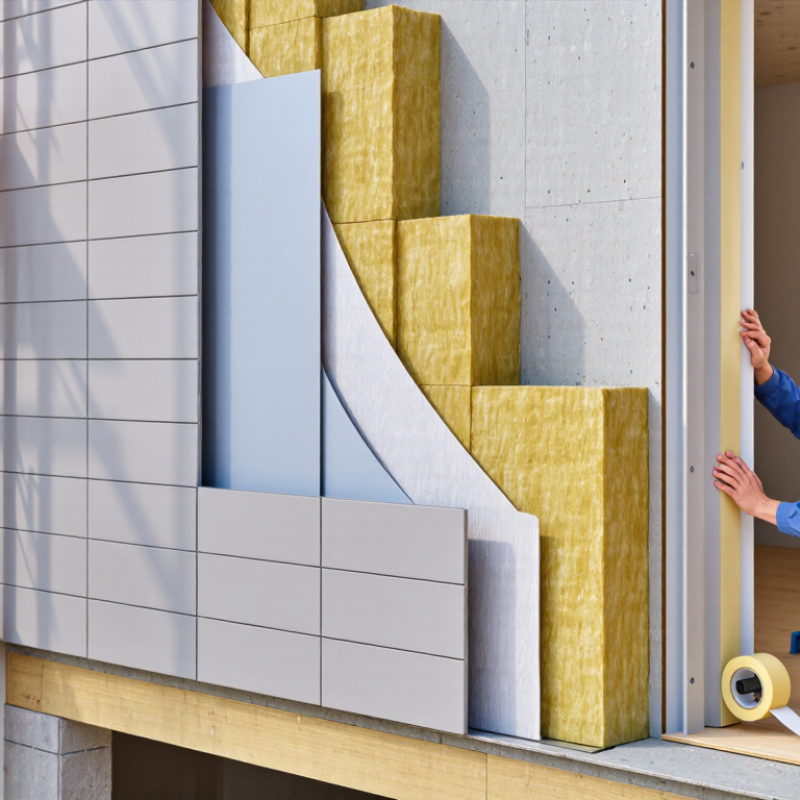
| Vapor-control membrane | Limit water vapor diffusion through the building assembly. | It does not provide significant insulation by itself; it helps preserve the effectiveness of surrounding insulation by reducing moisture accumulation. | Restricts vapor movement from the warmer or more humid side, depending on the climate and assembly design. | Usually on the warm-in-winter side of insulation in cold climates; placement varies by climate zone and wall design. | Vapor permeance is commonly classified as impermeable, semi-impermeable, semi-permeable, or permeable under building standards. | Seal laps, joints, penetrations, and service openings to maintain continuity. |
| Breathable water-resistive membrane | Stop wind-driven rain while allowing trapped vapor to escape. | Reduces air movement across insulation, helping prevent wind washing and unwanted convective heat loss. | Repels liquid water from the exterior while permitting water vapor diffusion toward the outside. | Outside the sheathing and behind the exterior cladding. | Designed to be water-resistant and vapor-permeable; exact permeance and water-resistance ratings vary by product and standard. | Install shingle-style with properly integrated flashings around windows, doors, and roof-wall transitions. |
| Air-barrier membrane | Reduce uncontrolled air leakage through the building envelope. | Limits convective heat transfer caused by air moving through gaps in walls, roofs, and floors. | Reduces moisture carried by air leakage, which can otherwise cause condensation inside assemblies. | May be installed on the interior, exterior, or within the assembly, depending on the envelope design. | Air leakage is evaluated at a specified pressure difference; low air leakage is the desired result. | Continuity is essential. Pay special attention to corners, fasteners, service penetrations, and transitions between materials. |
| Radiant-reflective membrane | Reflect radiant heat, particularly in roof and attic applications. | A low-emissivity surface reflects a portion of infrared radiation instead of absorbing it. | Some products also act as vapor or air control layers, but this function must be verified separately. | Facing an adjacent air space, commonly beneath a roof or above attic insulation. | Requires an adjacent air space to provide meaningful radiant resistance; it is not a direct replacement for bulk insulation. | Keep the reflective surface clean and unobstructed where the design depends on radiant reflection. |
| Insulated membrane or composite blanket | Combine a thin insulation layer with one or more control layers. | Slows conductive heat flow through enclosed gas cells, fibers, or foam, while the facing may reduce air movement or radiant transfer. | May resist liquid water and vapor, depending on the facing and core; it should not be assumed to dry in both directions. | Walls, roofs, floors, ducts, tanks, and other areas requiring a thin multi-function layer. | Thermal resistance is normally reported as an R-value or U-factor for the tested assembly. | Avoid compression, gaps, and thermal bridges; follow the required clearances for adjacent heat sources. |
| Drainage-plane membrane | Provide a controlled path for water that penetrates behind exterior cladding. | Can reduce wetting of insulation and sheathing, helping the assembly retain its intended thermal performance. | Directs liquid water downward and outward while some designs allow drying by vapor diffusion or ventilation. | Behind cladding, often with a small drainage or ventilation cavity. | Performance depends on water resistance, drainage openings, laps, and the continuity of flashings. | Maintain unobstructed drainage paths and integrate the membrane with sill, head, and corner flashings. |